
- On time = puntual, a la hora prevista del horario/agenda.
- In time = a tiempo, lo bastante pronto para lograr algo antes del límite.
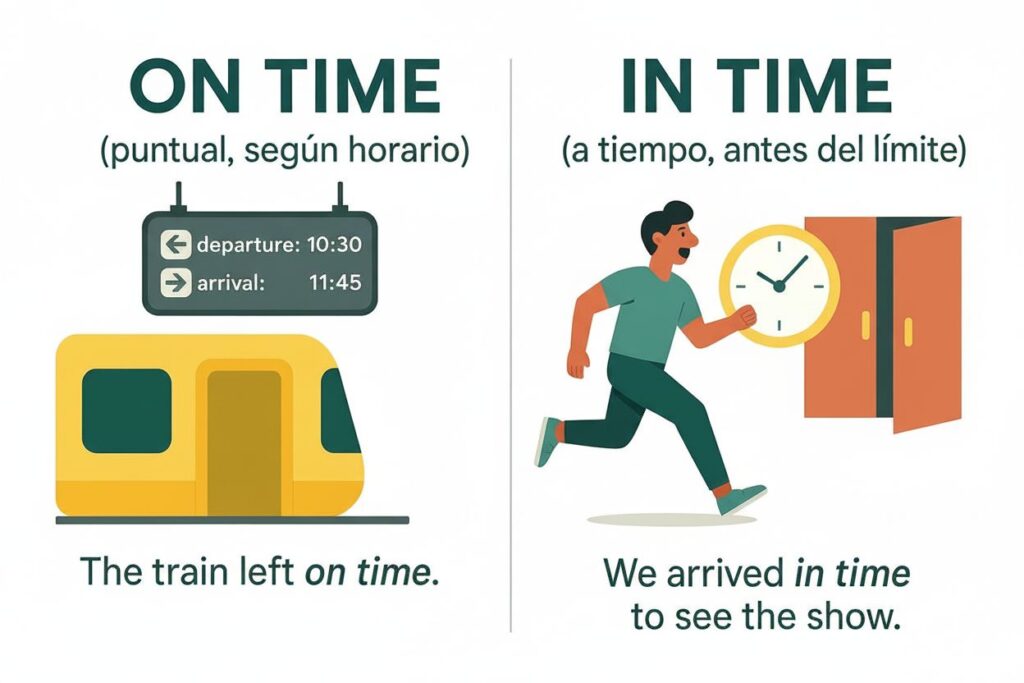
Uso de on time (puntual)
Cuando hay hora fija o plan.
- Trenes, reuniones, entregas programadas.
- Se usa con timetables y agendas: The meeting started on time.
- Intensificador habitual: right on time.
Ejemplos para el uso de "on time"
- The 9:30 train arrived on time.
- Please be on time for the interview.
Uso de "in time" (a tiempo)
- Patrones: in time for + sustantivo / in time to + verbo.
Ejemplos
- We got there in time for the exam.
- I arrived in time to print the slides.
- Just in time = por los pelos.
Ejemplos del uso de "in time"
- I woke up in time to catch the bus.
- You’re just in time for dessert!
In time on time: la diferencia en una tabla
Situación | ¿Reloj/horario? | Expresión | Patrón |
Tren llega a la hora prevista | Sí | on time | horario fijo |
Llegas antes de que cierre el banco | No (plazo) | in time | in time for cierre |
Entras justo para ver el gol | No (evento) | just in time | in time to see |
Proyecto termina según planning | Sí | on time | según plan |
Proyecto listo antes de un hito | No (plazo/hito) | in time | in time for the event |
Errores típicos
- Usar on time con plazos: ✗ on time for the deadline → ✓ in time for the deadline.
- Olvidar for/to con in time.
- Creer que on time = “temprano”: significa puntual.
Mini-guía de elección
- ¿Hay hora concreta en un horario? → on time.
- ¿Necesitas llegar antes de que sea tarde para hacer algo? → in time.
- ¿Casi tarde? → just in time.
Ejercicios para aprender el uso de "in time" y "on time"
1) The train left ___ (on time / in time) to follow the timetable.
2) I arrived ___ (on time / in time) to submit the application.
3) We weren’t ___ (on time / in time) for the movie; we missed the trailers only.
4) The package must be delivered ___ (on time / in time) according to the contract.
5) You got here ___ (on time / just in time)! They’re closing the doors.
Soluciones: 1) on time · 2) in time · 3) in time · 4) on time · 5) just in time.
1) Opción correcta (elige: on time / in time / just in time)
- The 8:15 train departed ___ .
- I arrived ___ to submit the application.
- We got home ___ to watch the news.
- Please be ___ for the interview.
- The project was finished ___ according to the schedule.
- She reached the gate ___ — they were about to close it.
Soluciones: 1) on time · 2) in time · 3) in time · 4) on time · 5) on time · 6) just in time.
2) Completa con for o to después de in time
- We arrived in time ___ the meeting.
- I woke up in time ___ catch the first bus.
- He called me in time ___ warn me.
- She got there in time ___ the presentation.
- Are we in time ___ see the trailer?
Soluciones: 1) for · 2) to · 3) to · 4) for · 5) to.
3) Detecta y corrige (si es necesario)
- I finished the report on time for the deadline.
- The flight landed on time.
- We weren’t on time to see the beginning.
- They arrived in time according to the timetable.
- You’re just in time!
Soluciones:
- ✗ → in time for the deadline.
- ✓ (correcta).
- ✗ → We weren’t in time to see the beginning.
- ✗ → They arrived on time according to the timetable.
- ✓ (correcta).
4) Reescribe usando la otra expresión sin cambiar el sentido
- The meeting started on time. → (usa in time)
- We got there in time for the exam. → (usa on time)
- He emailed the slides in time to present. → (usa on time)
Soluciones (una posible):
- We were in time to start the meeting as planned.
- We arrived on time for the scheduled exam.
- He sent the slides on time, so he could present.
5) Traduce al inglés con la forma correcta
- Si llegas puntual, entramos juntos.
- Llegamos a tiempo para ver el gol.
- El envío debe llegar según el horario.
- Ella llegó por los pelos.
Soluciones:
- If you arrive on time, we’ll go in together.
- We arrived in time to see the goal. (también: in time for the goal)
- The shipment must arrive on time.
- She arrived just in time.
Preguntas típicas del uso en "on time" o "in time"
1) ¿Puedo usar “on time” y “in time” indistintamente?
No. On time va con horarios; in time con plazos o llegar lo bastante pronto para hacer algo.
2) ¿Se usa “in time for” y “in time to”?
Sí: in time for + sustantivo (in time for the meeting) y in time to + verbo (in time to speak).
3) ¿Qué significa “just in time”?
“Por los pelos”; llegas justo antes de que sea tarde.
4) ¿“On time” funciona con personas y cosas?
Sí: You were on time / The service launched on time.
5) ¿Hay diferencia entre inglés británico y americano?
La distinción in time / on time es la misma en ambos; aplica las reglas de arriba.